
How Bench Warrants Work in Lamar County
People say bench warrant. The courts rarely do. In official Lamar County paperwork, the same paper may be styled an arrest warrant, a capias, or a capias pro fine, with the court and the case type deciding which rule applies. Each label covers court process tied to nonappearance, contempt, or a broken order. The city courts put their own warnings in writing. Paris cautions that failing to honor a written promise to appear can bring an arrest warrant and added cost. Reno states that a missed court date or ignored order can do the same. Those are city rules, not a promise that every missed payment countywide ends in a warrant.
Lamar County Bench Warrant Triggers
Start with the case itself. A missed setting is not an unpaid final judgment. A skipped payment-plan term is a third thing. Gather the citation, court notice, payment record, and any prior order before calling a Lamar County clerk. City courts add their own deadlines. Paris Municipal Court wants a citation appearance within ten days through an approved route. Reno asks anyone who cannot pay in full to appear on the scheduled date and request a plan. One city's procedure does not bind another court.
Bench Warrant Issuance in Lamar County
The path often starts with a court date or order, then a failure to appear or comply, then a judge's decision about process. The actual sequence depends on the notice and case. A clerk can identify the docket event but cannot give legal advice or promise a safe surrender.
For a JP or municipal fine case, a capias pro fine has its own statutory process. The official Texas Chapter 45A text covers justice and municipal court matters.
The Chapter 45A source shows the statute that governs this fine process.
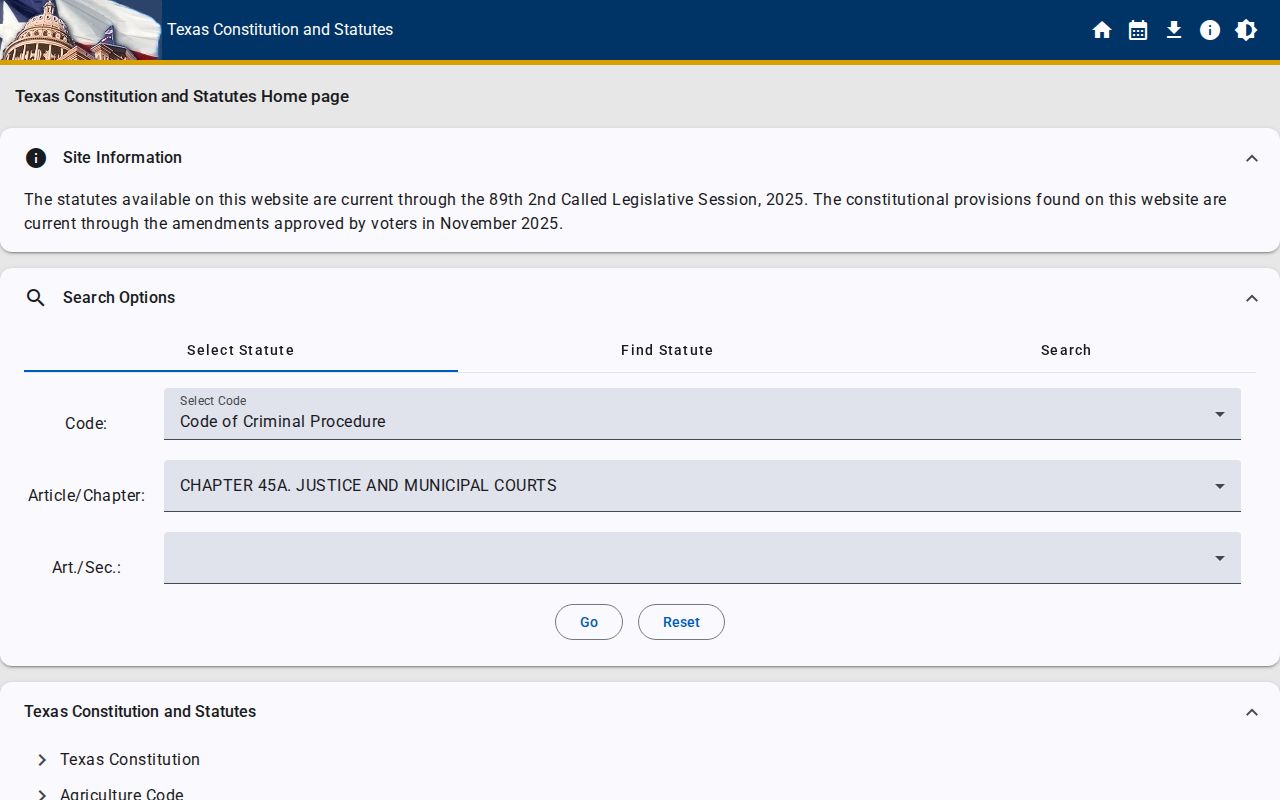
That chapter sets statewide procedure only; it promises no Lamar County bond amount and no guaranteed outcome in a single case.
Lamar County Capias Pro Fine Rules
In Lamar County, a capias pro fine is justice or municipal court process tied to a fine judgment. Article 45A.259 governs it. The process must state the judgment amount and direct how the person is brought before the court. Undue hardship gets its own hearing path. Some pre-execution rules help. With proper notice and a hearing set, or after a voluntary appearance and a good-faith effort to resolve the case, the court must recall the capias. Even so, no payment clears every warrant.
How Bench and Arrest Warrants Differ
Both papers can end in arrest. They come from different court events, though. Bench-type process grows out of a court obligation, while an arrest warrant rests on a sworn complaint or a probable-cause basis. One file can hold both. It may also carry a related case entry or service record. So ask the issuing court for the exact name of its process. A Paris or Reno case belongs at that city court, and a Lamar County JP matter belongs to that precinct.
| Question | Bench-type process | Arrest warrant |
|---|---|---|
| Common trigger | Missed date or court order | Complaint and probable cause |
| First contact | Court that set the matter | Issuing magistrate or court |
| Useful record | Docket event and notice | Cause number and warrant status |
Lamar County Bench Warrant Terms
Court papers use labels callers never say. Ask the Lamar County clerk to name the formal process the court issued. Then ask for the status and next date.
- Capias
- A court writ directing an officer to arrest or bring a person before the court.
- Capias pro fine
- Fine-judgment process used in justice and municipal court cases.
- Recall
- A court action that withdraws process; ask for the written order or docket entry.
- Quash
- A court sets aside a process after a request or ruling.
- FTA
- Failure to appear; a court event that may have separate reporting effects.
A reported FTA, a fine, and an active warrant are three different things. Confirm each with the issuing Lamar County court.
Clearing a Bench Warrant in Lamar County
Ask the court what it wants. That may be an appearance, a motion, a payment plan, a bond, or contact through a lawyer. Lamar County publishes no amnesty page, universal bond schedule, walk-in surrender form, or Sheriff warrant-window hours. Use a careful order:
- Call the court named on the citation or docket.
- Ask for the exact process and current status.
- Ask whether counsel should arrange an appearance or motion.
- Follow the court's payment or hearing instructions.
- Keep proof and confirm that the court updated the record.
Reno warns that an officer contact may lead to custody when a warrant is active. Voluntary appearance does not guarantee release without arrest.
For routing a case to the right office, the Lamar County warrant records overview lists the county and city contacts.
Lamar County Bench Warrant Plans Need Follow-Through
Payment plans need follow-through. Reno's payment page tells anyone who cannot pay in full to appear on the scheduled date and request a plan. It warns that a broken plan means a warrant. A payment alone proves little. It does not show whether the court recalled the process or updated a separate system. Paris writes its own appearance and payment rules. The city offers a 24-hour drop box and cuts off payments after 4:45 p.m. For a Lamar County case in either city, use that court's current page and call before relying on any payment route.
Lamar County Courts That Issue Bench Warrants
District cases start with the District Clerk. They run through the 6th or 62nd District Court. County-level criminal cases may go through County Court at Law and the County Clerk instead. Six JP courts and the municipal courts control their own lower-level files. The District Clerk sits at 119 N Main Street in Paris and lists 903-737-2427. The County Clerk lists 903-737-2420. The Lamar County Sheriff, at 125 Brown Avenue, lists 903-737-2400 for law-enforcement routing.
No Lamar County office can substitute for the court named on the paper, so call that court.
Lamar County Bench Warrant Status
Clerk: A Lamar County clerk can run a case search, walk you through filing or appearance steps, and hand over any court records on hand. The District Clerk's staff will not give legal advice. So ask the court itself where your case stands on the docket, and put questions about arrest risk, surrender, or asking the court to recall a warrant to your lawyer. If you already paid or appeared, bring the receipt or order number and confirm it landed on the right case. Also ask whether the court passed the update along to any reporting agency.